
History
Cold Oak Shelter, Lee County
Three thousand years ago, families came back again and again to a dry rock overhang in what is now Lee County.
Visit it
Lee County
The exact place is withheld to protect the site.

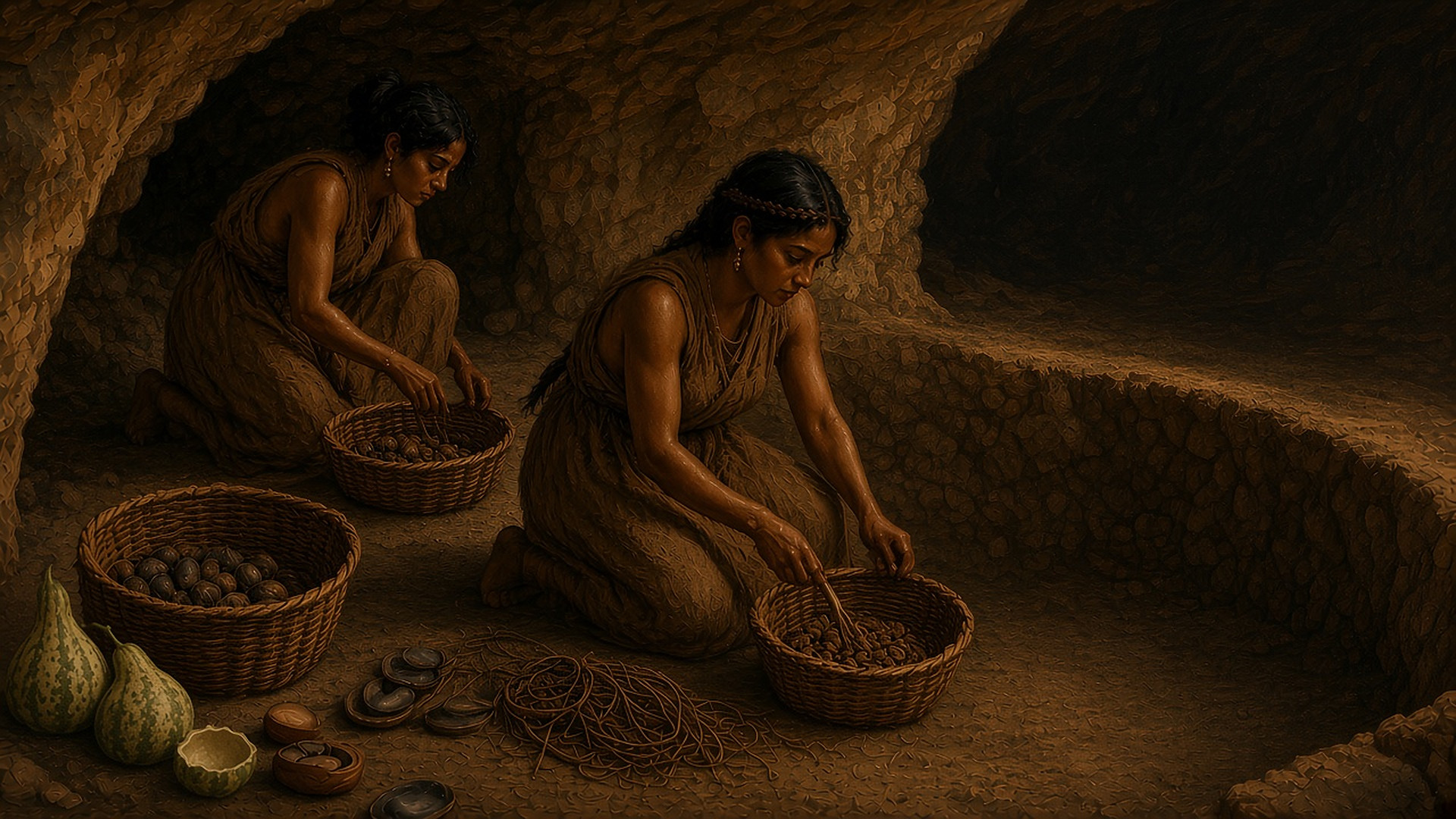
Under the ledge they cracked nuts, worked wood, twisted cordage and dug storage pits. What they left in those pits has made Cold Oak one of the places archaeologists turn to when they ask how farming began in eastern North America.
Who lived here, and when
The main use of the shelter came at the end of the Late Archaic period (opens in a new tab), about 1200 to 1000 BC. People did not live there year-round. The plant remains and tools point to seasonal visits spread through the year. These were still hunter-gatherers who leaned on what the woods gave them, but by about 1200 BC they were relying more and more on crops from their own gardens.
What the pits held
The dry deposits kept things that usually rot away. Wild foods were mostly hickory nuts, walnuts, red and white oak acorns and chestnuts. In the storage pits were charred and uncharred seeds of sunflower, goosefoot, knotweed, marshelder and squash, and possibly maygrass. All of them belong to the Eastern Agricultural Complex (opens in a new tab), the native crops that make eastern North America one of roughly ten places in the world where people domesticated plants on their own.
Many of those plants pass for weeds today. Goosefoot and knotweed come up in any disturbed ground. But they yield heavy crops of small starchy seeds, while sunflower and marshelder give oily ones. Archaeologists recognize domestication through slow changes over centuries: bigger seeds, new shapes and thinner seed coats.
Other finds fill in daily life. Bits of cordage and a wooden tool that may have been used in weaving point to textile work. Piles of wood chips and part of a stone celt suggest woodworking. Hunters brought back white-tailed deer, turkey, squirrel and black bear, and the deposits also held box turtle, fish bone, crayfish and freshwater mussel shell.
Gardens in the forest
Archaeologists still debate why foragers began to plant. Some think garden seed made up for nut harvests that failed in bad years; others see stored seed as insurance for the lean months of late winter. Kristen Gremillion’s 1993 study of plant husbandry at Cold Oak (opens in a new tab) placed the site at the Archaic–Woodland transition.
After 1000 BC, seeds of cultivated plants rose sharply (opens in a new tab) in the deposits while seeds of forest plants fell away, a sign that clearings and gardens were spreading around the camps. Her study of preserved human paleofeces (opens in a new tab) from two eastern Kentucky rockshelters found that native crops were sometimes a real part of the diet by about 1000 BC, a thousand years before farming economies spread across the region.
Kentucky today
Looters had already done heavy damage when Forest Service archaeologists, who recorded the shelter in 1983, ran salvage digs there in 1984. An Ohio State University team returned in 1994 with National Geographic Society support. Those are study dates; the story and its map pin use the years people lived there.
Cold Oak is a protected archaeological site. This story names only the county; the shelter is shown only by an approximate area, at the county level, and its pin is a county-level point. Under Kentucky law, no one may dig at or take artifacts from an archaeological site without a permit.
Map
Sources and research
Cite this story
Cite this story
Published . Last revised .
Chicago
Snowden, Shannon. "Cold Oak Shelter, Lee County." Kentucky History Drive. Published November 13, 2026. Last revised November 13, 2026. https://kyhistorydrive.com/stories/cold-oak-shelter-lee-county/.
MLA
Snowden, Shannon. "Cold Oak Shelter, Lee County." Kentucky History Drive, published 13 Nov. 2026, last revised 13 Nov. 2026, https://kyhistorydrive.com/stories/cold-oak-shelter-lee-county/.