
Caves
The Woman from Short Cave
Sometime between 1811 and 1813 (the accounts differ), as the country went to war with Britain, men digging saltpeter in Short Cave, in Edmonson County, opened a grave.
Visit it
Edmonson County
The exact place is withheld to protect the site.

Inside was a Native American woman who had been laid to rest with great care, long before anyone now remembers. What happened to her afterward says as much about the people who found her as about the people who buried her.
A careful burial

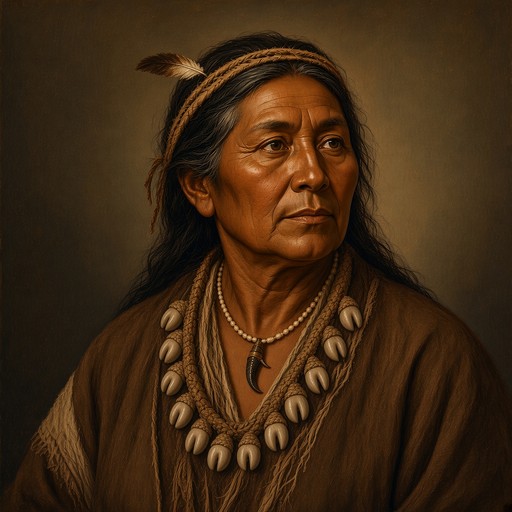
Charles Wilkins, a Lexington merchant who owned Mammoth Cave and its saltpeter works, described the grave in a letter. She was found "at a depth of 10 feet from the surface of the cave in a sitting posture, encased in broadstones, standing on their edges, with a flat stone covering the hole." (opens in a new tab) She was wrapped in coarse cloth and deer skins, with her working tools, beads, feathers and ornaments beside her.
Bags made of the same cloth held her jewels, beads and trinkets, and beside her lay a cane flute worked with feathers, a finely made bowl and a collar of feathers (opens in a new tab). The name she carries today, Fawn Hoof, was given to her by later writers. No one knows what her own people called her.
No radiocarbon date has ever been determined (opens in a new tab). She was likely an older, respected member of her society (opens in a new tab).
Moved into Mammoth Cave
Wilkins had her carried into Mammoth Cave, in what is now Edmonson County, and set in the Rotunda, the first great room inside the cave. There about 70 enslaved laborers built and ran the leaching vats (opens in a new tab) that turned cave dirt into saltpeter for gunpowder. They objected to having her among them, and the owners moved her to a ledge in Gothic Avenue (opens in a new tab), an upper passage.
A traveling exhibit

In the fall of 1815, Nahum Ward, a land dealer from Marietta, Ohio, toured the cave and saw her. His account of the trip made Mammoth Cave famous. He asked the American Antiquarian Society (opens in a new tab) in Worcester, Massachusetts, to take her into its museum for safekeeping. Instead he kept her.
Wilkins first showed her in Lexington, where she was damaged (opens in a new tab), and in 1816 Ward took her east and charged 25 cents a look in town after town.
The Society received her in 1817, but she stayed on public view for decades. She was exhibited as the "Mammoth Cave Mummy" at the World's Fairs of 1876 and 1893, and in 1876 she went to the Smithsonian Institution, where she remains. Years of moving and display had already damaged her. In 1914 the Smithsonian removed what remained of her preserved tissue and kept only her skeleton (opens in a new tab).
Kentucky today
Her discovery came long before the Native American Graves Protection and Repatriation Act (opens in a new tab), which recognized that human remains of any ancestry "must at all times be treated with dignity and respect." (opens in a new tab) Mammoth Cave National Park now consults with tribal partners on how to tell her story. The Rotunda's vats still stand, and visitors can learn about the saltpeter miners and the ancient cavers of Salts Cave.
Short Cave is a protected archaeological site, and its location is not public. This story names only its county, Edmonson, and her map pin is a county-level point there. Under Kentucky law, no one may dig at or take artifacts from an archaeological site without a permit.
Map
People in this story
-

-

-


Sources and research
Cite this story
Cite this story
Published . Last revised .
Chicago
Snowden, Shannon. "The Woman from Short Cave." Kentucky History Drive. Published November 20, 2026. Last revised November 20, 2026. https://kyhistorydrive.com/stories/the-woman-from-short-cave/.
MLA
Snowden, Shannon. "The Woman from Short Cave." Kentucky History Drive, published 20 Nov. 2026, last revised 20 Nov. 2026, https://kyhistorydrive.com/stories/the-woman-from-short-cave/.