
History
Indian Knoll: Late Archaic Shell Midden in Ohio County
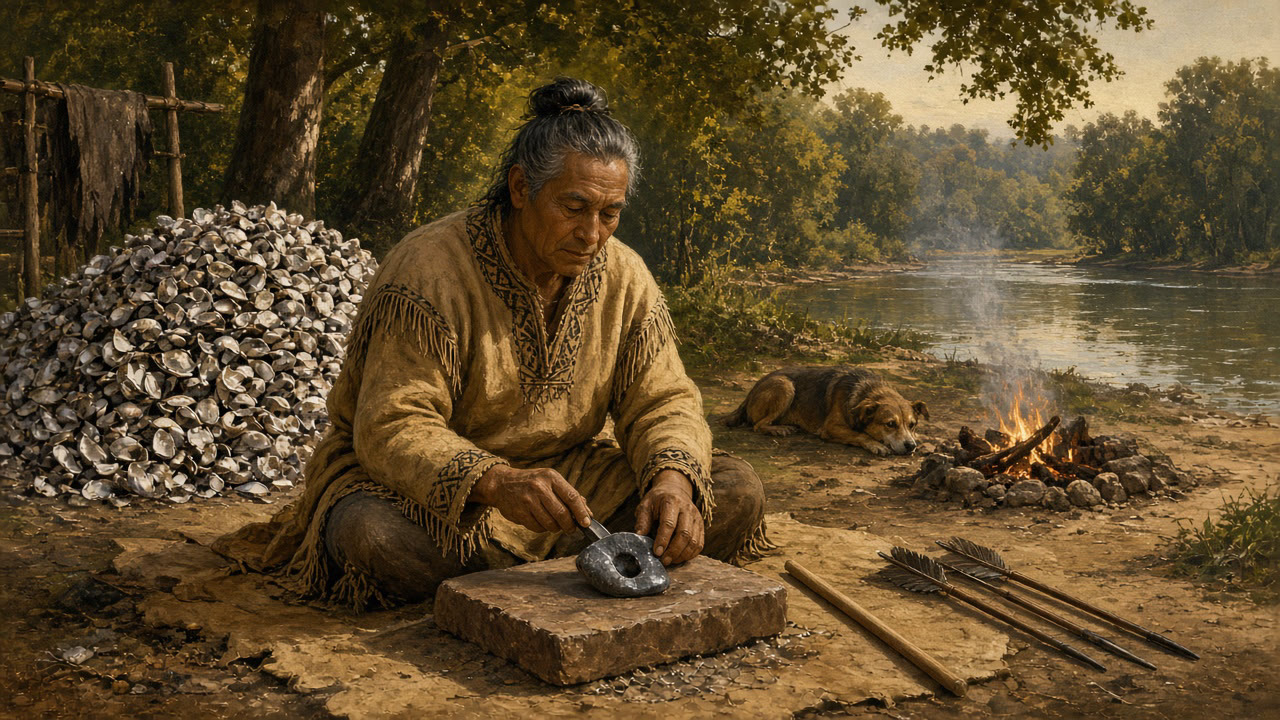
About five thousand years ago, families in Ohio County kept coming back to the same patch of ground.
Visit it
Ohio County
The exact place is withheld to protect the site.

They came for the freshwater mussels in the nearby shallows, and they stayed for the deer, turtles and nut trees. Each visit added to a growing mound of shell, ash and debris. Today we call it Indian Knoll, a shell midden (opens in a new tab) that has become one of the best-known sites of the Archaic period (opens in a new tab) in North America.
The people who lived here were hunters and gatherers, mainly during the Late Archaic (about 3000–1000 BCE). They did not stay in one place all year. They moved with the seasons, but they weren't wandering. Families planned each move using what they knew about when plants ripened, where animals went, and where to find stone and other supplies.
Mussels were a steady food source. They were full of protein, easy to collect, simple to cook, and could be gathered any time of year. The skeletons even suggest who gathered them. Women and children likely collected shellfish in shallow water.
Many men have bony growths in the inner ear, a condition that forms after repeated exposure to cold water, so men probably dove for mussels in deeper water. Most people were fairly healthy, but their teeth were badly worn. Sandstone pestles and nutting stones left tiny bits of grit in their food, which slowly ground down the enamel.
In the late 1930s, during the Depression, Works Progress Administration (opens in a new tab) crews led by University of Kentucky archaeologists dug about 1.5 acres, roughly sixty percent of the site. They recorded hearths, roasting pits, burned clay floors and hundreds of human burials. They collected more than 50,000 artifacts, including spear points, bone pins, marine shell beads and bannerstones (opens in a new tab). The marine shell had traveled a long way to get here.
Some of the most moving finds were 23 dog burials. Archaic dogs were medium-sized, about 14 to 18 inches tall at the shoulder, and may have looked a little like wolves. Some dogs were buried in their own graves. Others were buried with adults or children.
People treated dogs in a way they treated no other animal. Their bones show they ate much the same food as people did.
Kentucky today
In the early 1990s, Indian Knoll and nineteen other Late Archaic shell middens in the region were named National Historic Landmarks (opens in a new tab). The site is protected, and its location stays off public maps. Ohio County holds one of the deepest records we have of Archaic family life, including the dogs that lived alongside those families.
Map
Sources and research (1)
Research notes and sources for the Indian Knoll: Late Archaic Shell Midden in Ohio County
Cite this story
Cite this story
Published . Last revised .
Chicago
Snowden, Shannon. "Indian Knoll: Late Archaic Shell Midden in Ohio County." Kentucky History Drive. Published August 29, 2026. Last revised October 26, 2026. https://kyhistorydrive.com/stories/indian-knoll-ohio-county/.
MLA
Snowden, Shannon. "Indian Knoll: Late Archaic Shell Midden in Ohio County." Kentucky History Drive, published 29 Aug. 2026, last revised 26 Oct. 2026, https://kyhistorydrive.com/stories/indian-knoll-ohio-county/.