
History
Buckner Site: Fort Ancient Villages in Bourbon County
The Buckner site is an archaeological site in Bourbon County, in the heart of the Inner Bluegrass.
Visit it
Bourbon County
The exact place is withheld to protect the site.
It belongs to the Middle Fort Ancient period, which dates to about 1200–1400 CE (opens in a new tab). Its builders were Native farming families who lived in Kentucky centuries before any European arrived.
Two villages around two plazas
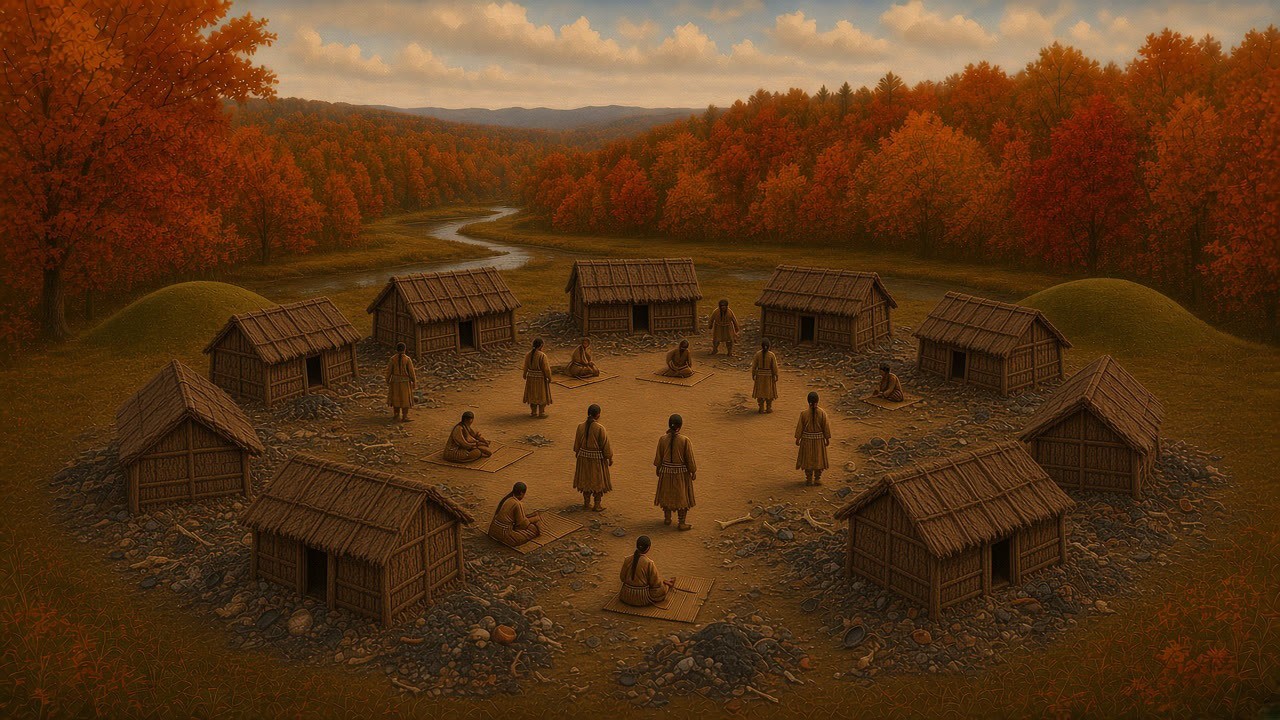
According to an account of the Buckner Site (opens in a new tab), Buckner has two large circular village areas. Each one surrounds its own central plaza. Several smaller special-use areas lie to the north and northeast of the main villages.
That plan fits a wider Fort Ancient pattern. Fort Ancient villages were laid out (opens in a new tab) in circles or rectangles around a central plaza used for ceremonies and gatherings. Houses were built of wattle and daub on wooden posts, set in shallow basins or wall trenches.
The Fort Ancient world
The Fort Ancient people farmed maize and lived in villages along the middle Ohio Valley. They made shell-tempered (opens in a new tab) cordmarked pottery, triangular projectile points and bone tools. Their villages were often enclosed by palisades.
The Middle Phase, about 1250 to 1450 CE, was a time of peak growth (opens in a new tab). Population rose, and settlements became larger and more complex. Many villages were stockaded with wooden posts, which suggests defensive needs as communities grew. Circular village plans with plazas and burial areas point to rule by elders (opens in a new tab) or councils rather than hereditary chiefs.
The Late Phase, from about 1450 to 1750 CE, brought climate stress and more conflict, and Fort Ancient communities eventually dispersed. Kentucky sites from that later era include Hardin Village and Fox Farm.
Excavation in the Depression
Buckner was excavated in the 1930s by William S. Webb. The work was salvage archaeology carried out during the Great Depression. Webb, a University of Kentucky physics professor, co-founded the university's Department of Anthropology and Archaeology with zoologist William D. Funkhouser in 1926 (some sources give 1927), according to the department's history (opens in a new tab). Beginning in 1933, he also coordinated excavations in the Tennessee Valley.
Depression-era projects like these recorded many Kentucky sites before farming or construction could damage them. Other Fort Ancient villages in the Bluegrass include Singer-Hieronymus and the Muir site.
National Register listing
The site was added to the National Register of Historic Places on January 27, 1983. The National Park Service's NPGallery record (opens in a new tab) lists its significance as prehistoric, with a period of significance of 1000–1499 AD. The record keeps the site's address restricted, which is standard protection for archaeological sites.
Kentucky today
To protect the site, this story places Buckner only in Bourbon County. The site deserves respect as a place where Native families lived and farmed.
Map
People in this story

Sources and research
Cite this story
Cite this story
Published . Last revised .
Chicago
Snowden, Shannon. "Buckner Site: Fort Ancient Villages in Bourbon County." Kentucky History Drive. Published October 24, 2026. Last revised October 24, 2026. https://kyhistorydrive.com/stories/buckner-site-fort-ancient-villages/.
MLA
Snowden, Shannon. "Buckner Site: Fort Ancient Villages in Bourbon County." Kentucky History Drive, published 24 Oct. 2026, last revised 24 Oct. 2026, https://kyhistorydrive.com/stories/buckner-site-fort-ancient-villages/.